Balance in Blackberry Season - A Seasonal Reflection
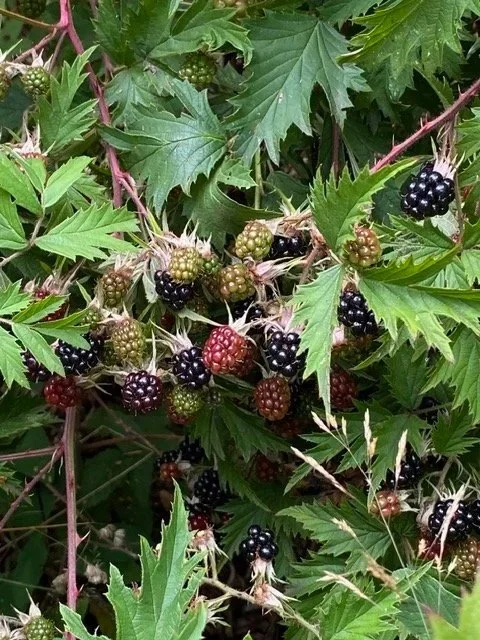
As we approach the Autumnal Equinox, the natural world offers both an opportunity and a metaphor for finding balance in our health, our energy, and our lives.
We transition through the seasons four times every year, but it seems to me that the transition from summer into autumn particularly invites us to notice balance.
Perhaps it is because the Autumnal Equinox itself represents a moment of near balance between daylight and darkness. Or perhaps it is because we can actually see and feel the changes happening around us: shortening days, cooler mornings, changing leaves, different foods at the market, and the gradual shift from the expansive energy of summer toward the quieter seasons ahead.
Our bodies and brains notice these changes, too.
I don’t think balance during a season of transition is about keeping everything exactly the same.
Perhaps it is about learning how to adapt.
Seasonal transitions can be a useful invitation to notice the transitions happening in our own lives.
After midlife, those transitions may include winding down a career, considering retirement or part-time work, adjusting to changes within our families, or simply wondering how we want to use our time and energy in the years ahead.
We may also become more aware of our health. We notice changes in energy, sleep, strength, or cognitive sharpness that we might once have ignored.
None of this necessarily means that something is wrong.
Sometimes it simply means that conditions have changed, and our brains and bodies are asking us to change with them.
THE SHIFT IN SEASON
While thinking about the transition from summer to autumn, I found myself remembering the farm where I lived for almost twenty years and raised my children.
We always had horses, and we had our own name for this particular transition.
We called it Blackberry Season.
The best wild blackberries on our farm were usually ready in early September, warm from the late-summer sun, dark purple and sweet, so blackberry season was already memorable.
But something else happened at about the same time.
As the days grew shorter and the nights cooler, the horses began growing their winter coats.
At first, they didn't become beautifully fluffy winter horses. They just looked a little rough.
A little scruffy.
Their coats changed texture. Their energy sometimes seemed different. They were responding to shorter daylight, cooler temperatures, and all the subtle signals telling their bodies that another season was coming.
I've learned a great deal from the animals I've been fortunate enough to spend time with, and lately I've been thinking that we humans have a Blackberry Season, too.
For the most part, our brains and bodies adapt to seasonal change remarkably well.
But sometimes the transition shows around the edges.
And sometimes those rough edges are simply reminders that a little extra attention might be helpful.
WE MAY GET A LITTLE SCRUFFY
Our version of Blackberry Season can show up in surprisingly ordinary ways.
Our bodies change. Summer skin and hair may feel different as temperatures cool and indoor heating begins. The routines that worked beautifully in July may need a little adjustment by October.
Our food changes. Berries, tomatoes, peaches, and summer salads begin giving way to apples, squash, root vegetables, beans, soups, and stews. Rather than seeing that change as a loss, we can use it as another way to continue nourishing the brain with colorful plants, fiber, healthy fats, and satisfying whole foods.
Our emotions may feel a little raw. Transitions and uncertainty can be surprisingly tiring. We can move from feeling completely at one with the universe one day to vaguely unsettled the next, sometimes without knowing exactly why.
Our rhythms change. There is less daylight. Mornings may be darker. We may spend less time outdoors. Sleep and activity patterns can shift almost without our noticing.
Autumn asks us to adjust.
And perhaps that is what balance really means.
Not standing perfectly still, but continually making small adjustments as the world changes around us.
A PINCH OF SCIENCE
There is good reason to think that our brains notice seasonal change.
Light is one of the most important signals regulating our circadian rhythms; the approximately 24-hour biological patterns that influence sleep and wakefulness, hormone release, body temperature, alertness, and many other physiological processes.
As autumn progresses and daylight decreases, the timing and amount of light reaching our eyes changes. Spending time outdoors, particularly earlier in the day, can help reinforce the signals our brains use to regulate those daily rhythms.
Our movement patterns can change as well. Long summer evenings make it easy to walk after dinner, garden, swim, or simply spend more time outside. When cooler temperatures and darkness send us indoors, physical activity can gradually decrease, yet regular movement remains one of our most reliable tools for supporting cardiovascular and brain health.
Seasonal eating can change without sacrificing brain-healthy nutrition. Many autumn foods fit beautifully into a MIND-style eating pattern: dark, leafy greens, like chard and kale, and the root vegetables long associated with winter, beans and lentils, whole grains, nuts, olive oil, poultry and fish. A pot of vegetable-and-bean soup can be just as brain nourishing as a summer salad, and perhaps considerably more appealing on a rainy Fall evening.
And nature itself remains available to us.
Research on time spent in natural environments suggests benefits for stress, mood, attention, and mental restoration. We don't have to wait for perfect hiking weather. A walk on a forest path among changing trees, a little quiet time putting the garden “to bed”, or simply noticing the natural world around us can provide a restorative pause.
Science doesn't tell us that our brains need protection from Autumn or seasonal change, but rather we are reminded that our brains are responsive to their environment.
And that gives us something useful to work with.
Instead of trying to carry our summer routines unchanged into autumn, we can ask a better question:
What does my brain need in this season?
Maybe this:
Keep the light. Step outdoors in the morning when you can. Open the curtains. Notice the sky. Let natural light help anchor your daily rhythm.
Keep moving. If evening walks become difficult, move them earlier, shorten them, or find an indoor alternative. The season can change without losing the habit.
Change the bowl, not the principle. Trade the summer salad for soup filled with vegetables, beans, herbs, and whole grains. Brain-healthy eating doesn't have to look the same in every season.
Keep some green in your life. Walk among trees, tend a garden, visit a park, or simply stop long enough to notice what is changing outside your own window.
Protect your rest. Shorter days can be a useful reminder to reconsider evening routines, artificial light, and whether your schedule still supports the sleep your brain needs.
Leave a little margin. Transitions use energy. We don't necessarily need to fill every available space.
These aren't dramatic interventions. They are small adjustments.
And small adjustments are one of the ways living systems maintain balance.
INTEGRATING NATURE
The horses on our farm never worried about Blackberry Season.
They didn't resist their changing coats or wonder why they weren't feeling exactly as they had in June.
They responded to the signals around them.
Perhaps there is something worth learning from that.
Healthy aging isn't about forcing ourselves to remain unchanged. Neither is brain health.
Both require adaptation.
When we understand a little more about what our brains need: nourishing food, movement, restorative sleep, connection, stimulation, time outdoors, and periods of genuine rest, we can carry those principles with us while allowing the way we practice them to change with the season.
Balance isn't sameness. It is responsiveness.
And sometimes, before we settle comfortably into the next season, we may look, or feel, just a little bit scruffy.
As we approach the Autumnal Equinox
Perhaps we don't need an ambitious new wellness plan. Perhaps we simply need to notice.
What is changing around us? What is changing within us?
And is there one small adjustment that would help your brain and body move into autumn with a little more ease?
Make the soup. Take the morning walk. Go outside and look at the changing leaves. Turn the lights down a little earlier in the evening. Pick the blackberries while they're still there.
Balance doesn't have to mean getting everything right.
Sometimes it simply means paying attention, and responding with care.
Here's to a healthy, slightly scruffy, beautifully changing Blackberry Season
Next Steps or a Review:
In the Golden Clarity Protocol™, especially in the Lifestyle Upgrades Phases, we discuss the brain health building pillars of nourishment, movement, sleep and rest, along with the broader practices of creating sustainable habits that change with our lives.
What’s In My Brain Health Toolkit?
I mentioned the following in my last post … “ I structure my life around the change of the season. I do certain house cleaning and maintenance things on or near the equinoxes and solstices, not entirely because of any ritual or belief, but because it makes it easy to remember!” I also attend especially to my house plants that need a little help as the light changes.
But in terms of my “toolkit”, this is the time I make my “fire Cider” an herbal remedy I like to have on hand for the upcoming winter season. There’s just a bit of seasonal magic in the making and sharing of it, and it creates its own morning ritual: a reminder to treat myself, my health and my intention of wellness with sincerity and conscious effort. I use one of several recipes listed in the book ‘fire Cider” by Rosemary Gladstar. I got my copy years ago from Mountain Rose Herbs in Eugene, Oregon and I know they still carry it. (and no, I’m not an “affiliate”, though I might wish I were!).
I remain fairly minimalist in my “toolkit”, but I am sure to take my Vitamin D3 (because my blood test is always low up here at 47degrees North), and at the Autumnal Equinox I start using my “happy light” which is a 10,000 lux light that I place on my desk when I get up early to work. The additional light has been shown to be helpful in shorter days with regulating circadian rhythm and mood.
An Invitation:
If this perspective resonates with you, if you’ve been looking for a more thoughtful, grounded approach to brain health, especially after midlife, I invite you to explore the resources and services I offer here, including the Golden Clarity Protocol.
Not as something you have to take on or master, but as a way to better understand what already matters.
I look forward to walking this path with you.