The Flexible Mind: Why Your Brain Needs Challenge
I have some good news for those of us who occasionally wonder whether our daily Wordle is doing enough to keep our brains sharp…
You don’t have to give up Wordle. Or Sudoku, or crossword puzzles. Or whatever familiar challenge you enjoy over your morning coffee.
But you might want to add something that makes you work a little harder.
Our understanding of the aging brain has changed enormously over the course of my lifetime. When I was in nursing school in the early 1970s, the prevailing view was that the adult brain was essentially a finished product. Once we reached adulthood, the wiring was largely set. Aging, disease, or injury could take something away, but there wasn’t much expectation that the brain could reorganize or continue to change in meaningful ways.
That idea certainly influenced the way we thought about recovery after brain injury, too.
Fortunately, the science has changed.
We now understand neuroplasticity, the brain’s remarkable ability to change structurally and functionally in response to experience, as something that continues throughout life.
And that brings us to a concept I particularly like: cognitive fitness.
Occupied or challenged?
There is a difference between keeping your brain busy and asking it to do something difficult.
A puzzle you have been doing for years may be enjoyable. Reading the news keeps you informed. Scrolling through interesting articles may expose you to new ideas.
But familiarity allows the brain to become efficient. And efficiency, while generally a wonderful thing, isn’t always the same thing as challenge.
Think about something you know how to do very well. You may hardly have to think about it anymore.
Now compare that with learning something new. You make mistakes. You have to concentrate; you forget what comes next. You try again.
In other words, it can be mildly annoying. And that may be part of the point.
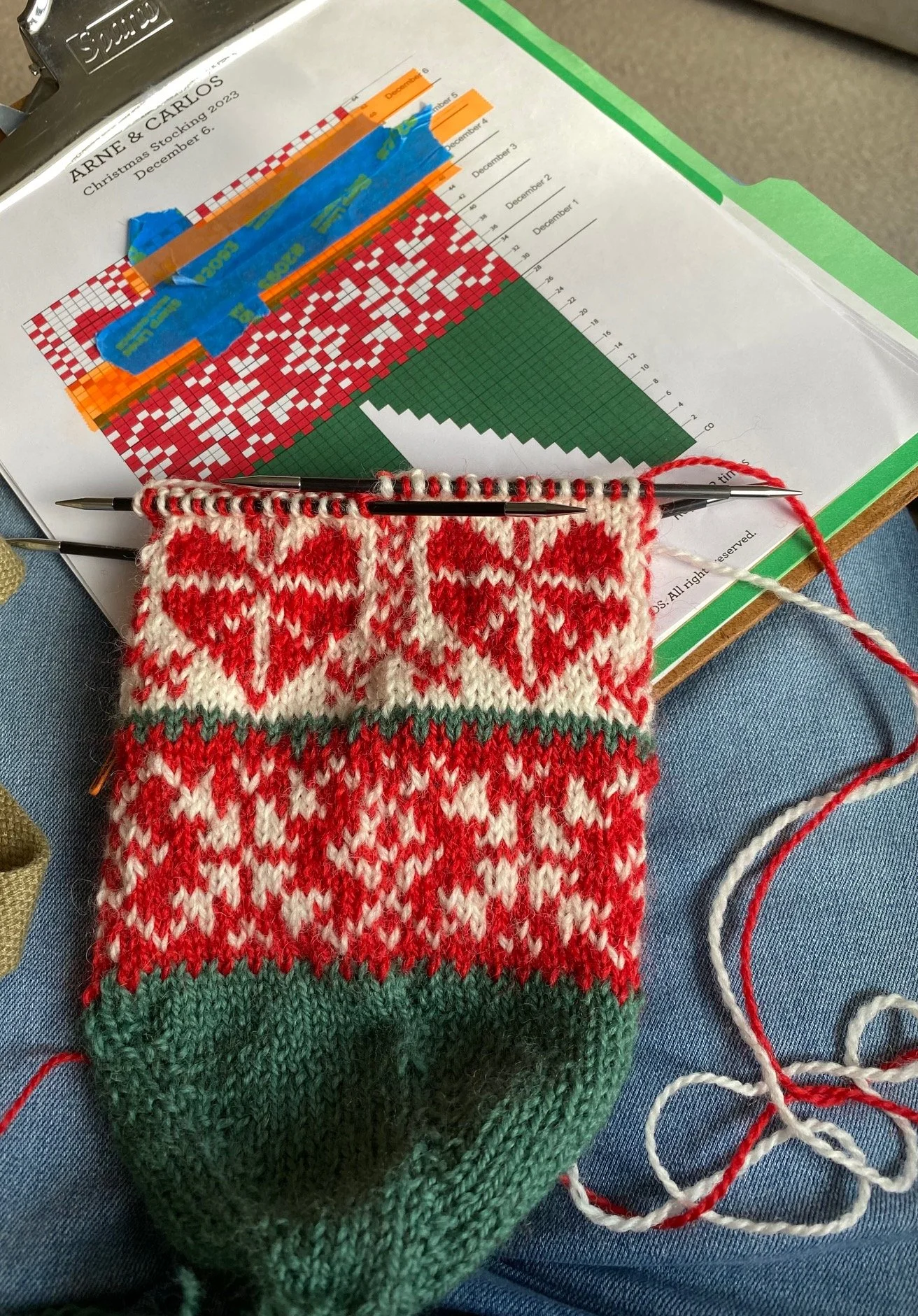
I experience this regularly with textiles. I have spun wool, knitted garments and woven (neck scarves mostly) for years, so I can choose a familiar pattern and settle comfortably into it.
Or I can choose the pattern that makes me think: Wait. What does that instruction mean?
Guess which one gives my brain more to do?
These days, especially since recovering from brain injury, I have tried to choose deliberately increasingly complex knitting projects (still just a neck scarf on my loom for now).
Not because there is anything wrong with easy knitting, sometimes easy knitting is exactly what I want, but because doing something more difficult, like a stitch pattern, or colorwork asks more of my brain.
A Brain with Options
Another helpful concept from brain science is cognitive reserve.
I think of cognitive reserve as giving the brain options. A resilient brain may have more ways to approach a problem, compensate for change, or find another route when the usual pathway isn't working quite as well.
Researchers are still learning what contributes to cognitive reserve over a lifetime, and there isn't one magic activity that creates it.
That matters, because brain health doesn't come down to whether you do crosswords or play chess.
It is much bigger, and much more interesting, than that.
One fascinating area of research involves people known as SuperAgers: adults over 80 whose memory performance resembles that of people decades younger. Scientists at Northwestern University have been studying SuperAgers for more than 25 years, looking for clues about both the biology and the life experiences associated with exceptional cognitive aging.
There isn't a SuperAger recipe. In fact, their lifestyles vary considerably.
But the research gives us another reason to reconsider the old assumption that significant cognitive decline is simply an unavoidable consequence of getting older.
Be a Beginner
Perhaps one of the most practical things we can take from all of this is permission to be a beginner.
Learn something you don't already know how to do.
Better yet, occasionally choose something that isn't naturally easy for you.
If you are comfortable with numbers, explore art or literature. If words are your natural territory, try learning the basics of a spreadsheet program. Take a dance class. Learn a language. Pick up an instrument.
I'm gradually returning to the piano. I’m not picking up exactly where I left off years ago, which is precisely what makes it useful.
My fingers and my brain have to work together again. I have to read the music, remember where my hands belong, listen to what I'm producing and correct mistakes as I go.
There is no autopilot available. And that is a very good thing.
Read Something That Takes a While
There is another form of cognitive fitness that I think deserves more attention in our increasingly abbreviated world: deep reading.
I've just committed to reading Les Misérables this winter with a group of family members. And yes, it's long. Very long.
But we will finish it in time for the local high school production of the musical stage play. I’m sure you can imagine the benefits of reading in concert with others, discussing occasionally as we go along, and eventually preparing for a wonderful community gathering. I think it might prove to be a highlight of the winter season.
And this is part of its richness. We'll move through it slowly, with discussions along the way. I’ll have to remember characters and relationships, follow themes across hundreds of pages, enter another historical period and culture, and occasionally reconsider something because someone in the group interpreted it differently than I did.
That is a very different cognitive experience from reading a short article and moving on to the next one.
And reading with a group, or book club, adds another layer.
Conversation requires us to listen, interpret, remember, respond, consider another person's point of view, and sometimes explain our own thinking more clearly.
Which may be one reason that meaningful social engagement continues to show up in research on healthy cognitive aging.
Take the Long Way Home
Here's an experiment I rather like:
Every once in a while, give yourself an Alternatives Day.
Do something your brain doesn't expect.
Take a different route to somewhere you go often, or take the long way home.
Decide to learn about a subject you are interested in but know almost nothing about.
Try cooking something from an unfamiliar cuisine.
Try reading a different kind of book; if you usually read mysteries, try an historical novel... you get the drift.
Choose a language you’ve always wanted to speak and learn the first few phrases of greeting or conversation in that language.
You don't have to become proficient. In fact, perhaps the goal is occasionally not to be proficient. There is something valuable about that awkward stage when we haven't figured everything out yet.
A beginner's mind has to pay attention.
Give Your Attention Somewhere to Go
Cognitive fitness also means protecting our ability to stay with something.
Our attention is constantly being invited elsewhere. There’s a notification dinging, another tab open, another information search and another quick answer.
So occasionally choose the alternative. Read for thirty uninterrupted minutes.
Practice the piano without checking your phone.
Work on the complicated knitting pattern until you've figured out those three troublesome rows.
Have a conversation without doing something else at the same time.
Give your brain one job, and then give it enough time to settle into that job.
A Flexible Mind
Cognitive fitness isn't about performing perfectly or trying to turn every hobby into a brain-training exercise.
And it certainly isn't about becoming anxious every time you forget a name or lose your keys.
It is something much more hopeful than that.
Our brains remain responsive to experience throughout life. We can continue learning, adapting, creating, connecting and occasionally doing things badly while we learn to do them better.
So keep your Wordle if you love it. But every once in a while, choose the harder knitting pattern.
Open the enormous novel.
Sit down at the piano.
Be willing to be a beginner again.
Your brain may appreciate the challenge.
What’s In My Brain Health Toolkit?
10,000-Lux Light
A recommendation from my rheumatologist, and especially welcome as our Pacific Northwest mornings grow darker. Bright light in the morning helps support my daily rhythm as the seasons change.
Sudoku
An almost-daily companion since my brain injury in 2019. It’s familiar now, but I still enjoy the concentration, pattern recognition, and small satisfaction of solving the puzzle.
My Current Knitting Project
A perfect example of today’s theme: I deliberately choose projects that ask me to learn something new—more complicated stitches, colorwork, or a pattern that makes me stop and think.
New Smartwool Gloves
Because brain health happens outside, too! A new pair from REI for those increasingly chilly morning walks. Warm hands make it much easier to keep walking as autumn settles in.
Vitamin D3
Back in my daily routine as the days shorten. Vitamin D plays important roles throughout the body, including the nervous system. (As always, supplements are best individualized to your own needs and health care guidance.)
Want to explore more ways your everyday habits can support your brain?
Start with the free Brain-Healthy Habits Check-In. Not as something you have to take on or master, but as a simple Brain Health Assessment and a way to better understand what already matters.